

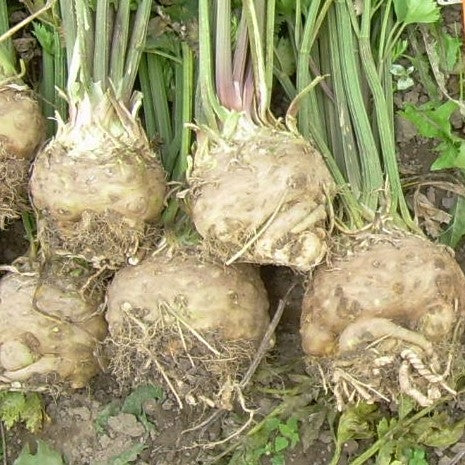
MONARCH CELERIAC - se12
Have a question?
MONARCH CELERIAC - se12
Dettagli
Scientific name: Apium graveolans variety rapaceum
Family: Umbelliferae
Brief history and botanical notes on the plant
Celeriac, particularly cultivated and prized in central and northern European countries where there is a well-established market for both fresh and processed produce, is known and cultivated only in some areas of northern Italy. Considered a vegetable of secondary importance for the conventional market, its trade in organic cultivation is showing some interest.
This biennial vegetable is a variety of celery. Its distinctive feature is the thickening of the root, which forms a compact globe about 15–20 cm in diameter. This portion of the root is white and firm inside and is eaten raw or cooked.

Family and variety
Celeriac belongs to the Umbelliferae family.
Varieties: Verona, with a rounded head and very tender, flavorful flesh; Prague giant, with an oblong, bulky head and very tender flesh.
Pedoclimatic needs
Celeriac stops growing at temperatures below 5-6°C and dies at temperatures below 0°C. The plants cannot tolerate temperatures above 30°C. The ideal climate is a temperate-humid one.
Sowing and transplanting times
Sowing can be done in seedbeds from late February to April, while transplanting can be done between May and mid-June when the seedlings have reached a height of 12-15 cm (pruning leaves and roots), maintaining a distance of about 35 cm between rows and 20 cm along the row.
Fertilizations
Celeriac is a heavy consumer, very demanding in macronutrients: N, P, and K, and also requires a good supply of micronutrients. Rich, fertile soil is ideal; well-tilled and well-rotted manure or compost should be spread before transplanting.
Cultivation care and irrigation
It doesn't require any special cultivation techniques. It's important to irrigate according to the weather conditions, both during transplanting and throughout the growing season. Maintaining a constant level of soil moisture is ideal. Water imbalances (either excess or deficient) cause severe stress to the plants.
Adversity
Cercospora and septoria: fungal diseases caused by two different pathogens that manifest themselves in very similar ways: on the leaves we can observe the appearance of spots of variable size that lead to their drying out and, in severe cases, to the wilting of the plants.
It is necessary to work preventively by choosing resistant or tolerant varieties, replacing the soil in the seedbeds, controlling the density of the seedlings and irrigation.
In the event of persistent rain, when the first stains appear, we can intervene with copper-based products.
Celeriac can also be subject to downy mildew, as well as attack by slugs and mole crickets.
Production and collection
Harvest begins in mid-August and continues until the first frosts. Yellowing of the leaves indicates that the flesh is firm and crisp (about 110-150 days after transplanting). Storage takes place in cold storage, without any treatment, and lasts for 4-5 months. One hectare yields approximately 30 quintals of produce.
Nutritional values
Celeriac is very low in calories (23 kcal per 100 g). It's a rich source of minerals, particularly selenium, but also calcium, iron, phosphorus, iodine, magnesium, manganese, potassium, copper, and sodium. It also contains significant amounts of vitamin A, B-complex vitamins, and vitamin C.
It therefore has remineralizing, tonic, digestive, diuretic and purifying properties for the liver and kidneys, and has expectorant functions for mucus and phlegm.
Thanks to these effects, it is particularly useful for loss of appetite and digestive difficulties, asthenia and convalescence, uricemia, bronchitis, sinusitis, and minor liver failure. It also stimulates digestive function and bile secretion.
Recent studies recognize celery's ability to reduce blood pressure and cholesterol.
Biodynamics
We recommend rooting for a few days before sowing, harvesting, and processing. If transplanting, soak the roots in water dynamized with 500 (horn manure) or spray 500 in the furrows. This will strongly stimulate rooting. It can be intercropped with any type of cabbage.
Since it is a heavy consumer, the ideal is to prepare the soil by spreading a mature biodynamic compost, while to avoid fungal diseases, use horsetail macerate.