


UNDERGROUND CLOVER - UNTREATED
Have a question?
UNDERGROUND CLOVER - UNTREATED
Dettagli
The underground clover, so called due to its marked geocarpism, is part of the group of self-seeding annual legumes which also includes other species belonging to the Trifolium and Medicago genera.
Thanks to its cycle suited to Mediterranean climates, its persistence in cultivation due to the phenomenon of self-seeding, its adaptability to poor soils (which among other things enriches it with nitrogen) and to continuous and severe grazing, underground clover is called to play an important role in many Southern European regions, not only as a fundamental resource of meadow-pasture systems, but also in unconventional uses, for example in multi-use systems in viticultural or forestry areas. For these reasons it should currently be considered as an emerging legume.
Native to the Mediterranean basin and the coastal areas of Western Europe, where it reaches as far as England, it is widespread, as a component of natural pastures, on over 17.5 million hectares. It is also present in southern Australia, where it was introduced accidentally in the 19th century, and here the subterranean clover has reached its maximum diffusion, affecting around 20 million hectares.
In Italy, underground clover, like other self-reseeding legumes, is still undeservedly underestimated. Its cultivation area (excluding densification) is estimated at just 15,000 ha, 80% located in Sardinia and the remainder in central-southern Italy, from Tuscany to Sicily.
The notable diversity of biological forms leads today to systematically classify the clover into three distinct species:
- Subterranean clover (T. subterraneum L.), the most widespread, the least sensitive to cold, the most suitable for acidic and loose soils, the most active in burying seeds;
- Brachycalycine clover (T. brachycalycinum Katzn and Morley), more adaptable to subalkaline and clayey soils, characterized by poor penetration of the reproductive organs into the soil;
- Janninic clover (T. yanninicum Katzn and Morley), suitable for humid areas, limitedly widespread in South-Eastern Europe and, sporadically, in Sardinia.
A fourth species, considered minor, has also recently been identified: T. israeliticum D. Zoh and Katzu.
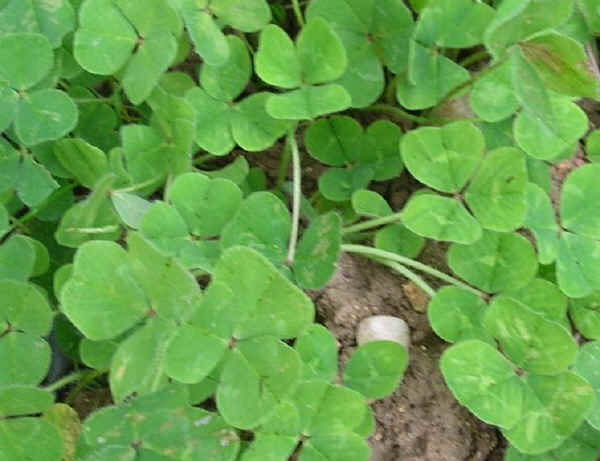 Subterranean clover - Trifolium subterraneum L. (photo Francesco Sodi)
Botanical characters
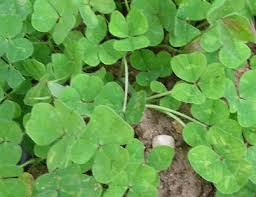
The underground clover is an autogamous, annual, autumn-spring cycle legume, low in size (15-30 cm) with shallow roots, creeping and hairy stems, trifoliate leaves with characteristic spots (useful for varietal recognition), peduncles flowers that bear flower heads made up of 2-3 white flowers which, after fertilisation, curve towards the ground and penetrate it for a few centimetres, depositing the mature legumes (called "glomeruli") which, very numerous, end up stratifying abundantly in and out of the ground.
The plant cover is singularly very low in height and extremely compact, with the bulk of the phytomass close to the ground (5-10 cm), with leaves located at the top and stems and reproductive organs located at the bottom, and functioning well even when subjected to frequent defoliations.
The glomeruli contain subspherical brown seeds (lilac in certain varieties). At maturation, the percentage of hard seeds is significant (from 65 to 90% depending on the cultivars) but, after the strong summer temperature variations, this percentage is reduced to 20-30%. The proportion of hard seeds is very important for the future of the crop: if it is too high, there is a risk of compromising self-seeding in the first year; if it is too low, there is a risk of "false starts", due to the exhaustion of all germinable seeds at the first autumn rains, with consequent compromise of subsequent births, which are also very useful in the event of failures due to recurrences of drought. Generally, the rate of hard seeds must be greater the more arid the environments are and the more pronounced the temperature changes are.
The loss of hardness can also occur rapidly as a result of the passage of fire (hence the pastoral fires specifically implemented to enrich the pastures with legumes).
The persistence of subterranean clover is closely linked to the fate of the seeds produced and the dynamics of the seed stock in the soil.
Naturally, the fate of the seeds is conditioned by many factors, among which the initial hardness (generally greater in the early varieties), the degree of deepening of the glomeruli in the soil (less in the brachycalicine type), the dimensions of the seeds ( the small ones germinate earlier as they require less water); the presence of predatory insects. Generally, under conditions of correct management, the self-seeding rate (ratio between the number of seedlings present in autumn and the number of seeds produced in the previous summer) tends to increase in the first 3-4 years and then decrease over the years subsequent ones.
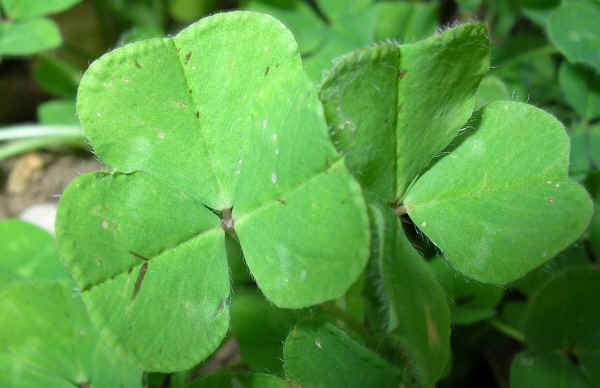 Subterranean clover - Trifolium subterraneum L. (photo Francesco Sodi)
Environmental needs and cultivation technique
Subterranean clover is a typical forage crop from acid soils (with the differences already mentioned for the different species) and from Mediterranean climates characterized by hot, dry summers and humid, mild winters (average minimum temperatures of the coldest month not lower than +1 ° C). In its typical form (T. subterraneum L.), it is a particularly heliophilous species and therefore very sensitive to the shading of grasses, but often also to the intraspecific competition that arises when it is not adequately used. In practice, it is precisely the methods of use that influence its persistence. It has been found that Lai, CGR, areic production of dry matter, and seed production increase when the clover is grazed (preferably with sheep) in a continuous and severe manner, even during the flowering period (which, contrary to what was believed in past, does not require suspension, but only a small lightening of the load) and, sometimes, even in summer when trampling by animals can favor self-seeding for better burial of the glomeruli.
Typically underground clover is alternated with cereals and kept in cultivation for 3-5 years. Sometimes (but rarely in Italy), there is no need to reseed it after the cereal, this is the case of the Australian "ley-farming" system which consists in following 3-4 years of underground clover with a cereal for 1-2 years and then allowing the clover pasture to regenerate spontaneously thanks to the hard seeds accumulated in the soil. More frequently, underground clover is used to thicken, or create from scratch, permanent out-of-rotation pastures of indefinite duration.
The planting as a monophyte pasture is carried out in autumn by carrying out shallow tillage and using, generally by broadcasting, 25-35 kg/ha of seed, after checking the presence of the specific rhizobia, which otherwise must be inoculated. In certain cases, to improve production stability, mixtures of varieties of different earliness are used. Intercrops with Lolium rigidum (self-reseeding annual grass) or with aquatic Phalaris (perennial) can be implemented to better use the nitrogen produced by the clover, but, to avoid the predominance of the grasses, frequent uses are necessary. To extend grazing almost all year round, intercropping with summer species such as "warm season grasses" or shrubs (e.g. Morus alba) has been successfully tried.
Another way of planting underground clover is by direct sowing in degraded swards, to be broadcast, with the same doses of seed used for pure cultivation, at the beginning of autumn. Sometimes, immediately after between sowing, it is advisable to graze the pre-existing sward residues, in order to facilitate the contact of the seeds with the soil through trampling and to reduce initial competition.
The non-negligible nitrogen fixation (estimated by various authors, between 100 and 200 kg/ha per year) recommends not administering this element. On the other hand, phosphate supplies are very useful, as long as they are not too abundant (40-60 kg/ha) in order to avoid the excessive development of the clover with consequent exaggerated introduction of nitrogen and exaggerated shading by the spontaneous grasses. In Spain, equilibrium doses even lower than 30 kg/ha of P2O5 are indicated.
Subterranean clover usually provides considerable quantities of seed (0.3-1.0 t/ha) which, with burial, form an abundant blanket in the first layers of the soil. Harvesting involves the use of special pneumatic machines that suck the glomeruli from the ground. The presence of some insects can lead to significant reductions in yields and, sometimes, compromise self-seeding itself.
There are currently no serious adversities for underground clover in Italy. However, in Australia they are fearsome: Kabatiella caulivora, Phytophtora clandestina and Pythium irregulara.
Variety and use
In Italy there is no Official Register of underground clover varieties. Currently, the varieties available on the market are mainly Australian: the most widespread are: for the underground clover “Geraldton” (early), “Seaton Park” (semi-early), “Woogenellup” (medium), “Mount Barker” ( semi-late), “Leura” (from Sardinian material, late); for the brachycalicine: “Clare” (medium); for the Janninic: “Trikkala” (from Greek germplasm, semi-early). Australian material is not always perfectly adapted to our environments. The CVs appear more promising. Spanish clovers of underground clover “Orellana” (early) and “Areces” (medium) and those of brachycalicine clover “Valmoreno” (semi-late) and “Gaitan” (late). Even more suitable are the recent Italian cultivars obtained in Sardinia, such as "Losa" (semi-early), "Campeda" (medium) and "Limbara" (semi-late) for the underground clover, and "Antas" (semi-late) for brachycalicine clover. Other improvement actions are conducted in Sicily and central Italy.
The orientation of genetic improvement is towards types with: resistance to cold, winter growth, rapid establishment, differentiated earliness, high seed production, balanced content of hard seeds to have at the same time rapid self-sowing and a stable seed bank in the soil . More recently, the Experimental Institute for Fodder Crops has selected lines of reduced vigor and high density suitable for unconventional uses (technical grassing).
Grazing, especially if continuous and intense, is the most congenial form of use for underground clover. In order not to compromise the settlement, it must not start before 3-4 weeks from the autumn resettlement, but subsequently it can continue, as already mentioned, until the summer. The yield of monolith crops varies from 4 to 8 t of dry matter/ha, in which 0.1-0.4 t of grazing glomeruli must be added. Certain varieties with a high estrogen content (mainly formononetin, belonging to the isoflavone group) can compromise the fecundity of animals, but genetic improvement has now reduced the problem.
Due to its exceptional plasticity, underground clover, like other self-reseeding annual legumes, finds ample space for use even in unconventional uses. For example:
As a cover crop in tree plantings or vineyards, the cycle of the earliest cultivars, ideal for erosion control in autumn-winter and for the mulching action (covering the soil with dry plant residues) in summer, appears completely independent of that of the vine, furthermore, during its dormancy period, grazing by sheep is possible, with a non-negligible added value in the framework of multi-purpose viticultural-pastoral systems;
As a cover crop in rotations between herbaceous crops (for example corn-sunflower) to improve sustainability and conserve, with limited inputs, soil fertility;
For grassing of firebreaks in forest areas, to limit soil losses and, with grazing, reduce fire risks;
For the creation of swards under forest cover to allow animals to keep the undergrowth clean and less combustible, for its greater resistance to shading, the brachycalicine clover seems particularly suitable for this role.